Why You Can Do It on the Reformer and Not on the Mat
Quick Answer: The reformer’s springs assist through part of every movement and provide external stability through all of it, so your deep stabilisers do less than they would unaided. The carriage also guides the movement path, removing the control demand that mat work places on you. Neither is worse, and they train different things. If mat work exposes you, it is showing you a genuine gap rather than a failure of your reformer training.
You are stronger and more capable than six months ago, and a mat class still finds every weakness you have.
This blog has covered why footwork feels different on different machines and why instructors keep adjusting your spring tension. This is the bigger version of the same question, and it explains what the springs are actually doing.
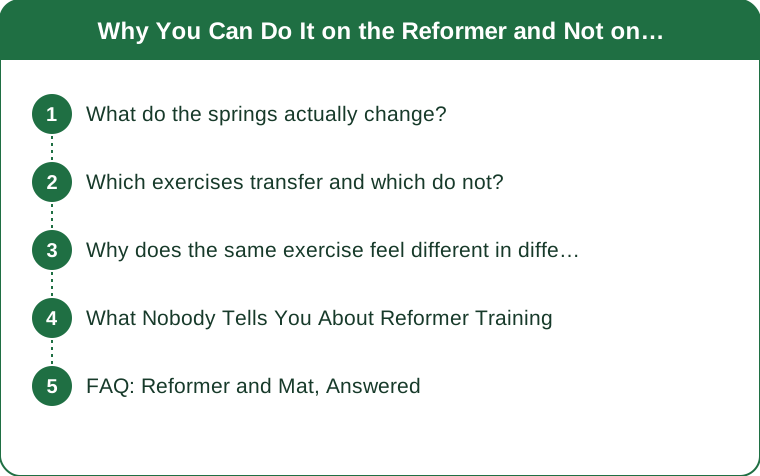
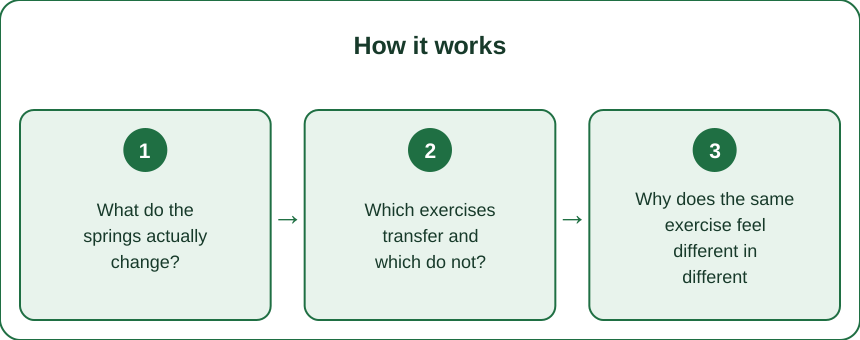
What do the springs actually change?
They alter both the load and the stability demand, and the second is the one people miss.
Springs assist in some positions and resist in others. In footwork, the springs resist your push. In many other exercises, the same springs assist you in returning, effectively removing part of the work. This is why heavier springs can make an exercise easier rather than harder, which is counterintuitive.
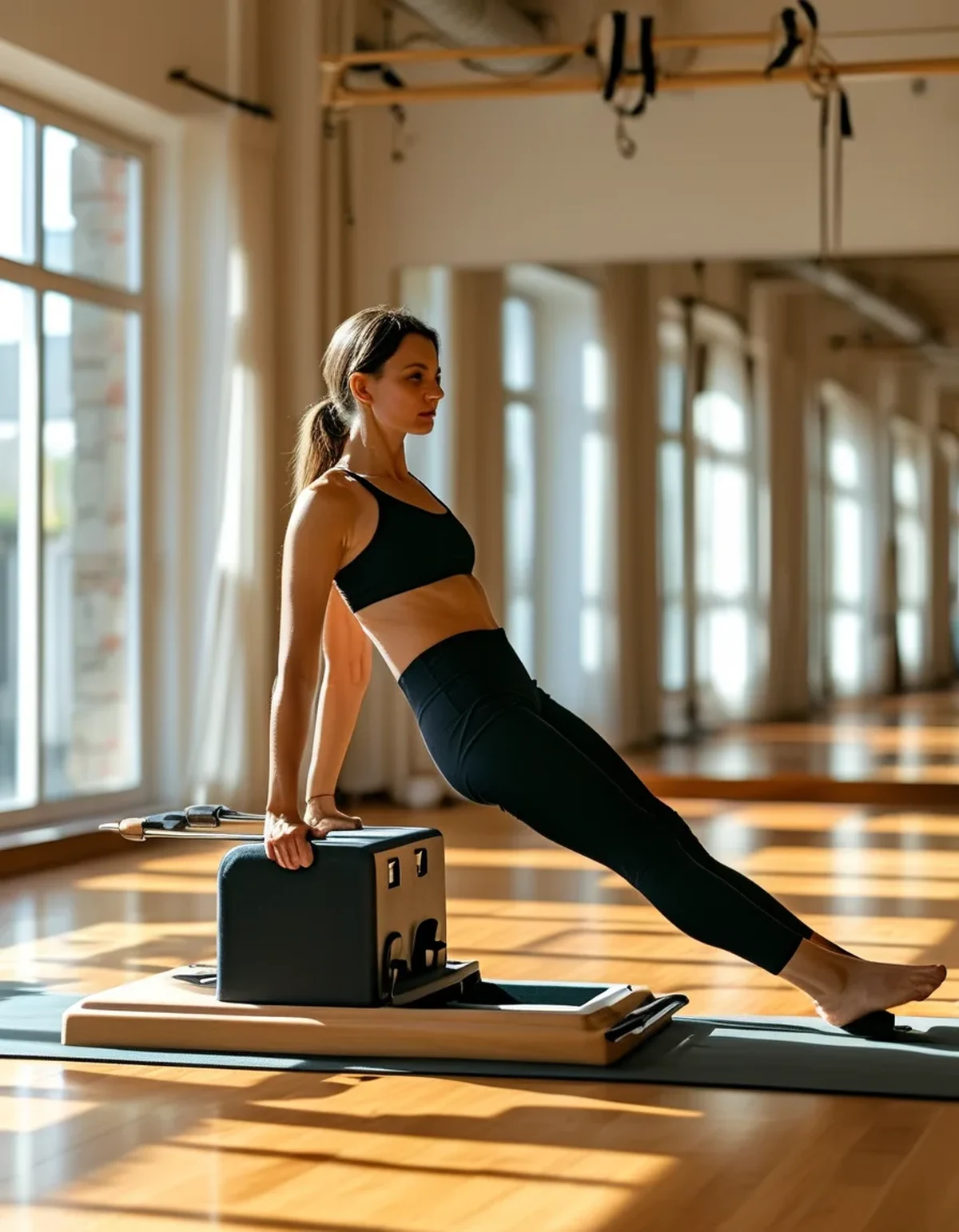
The carriage provides external stability throughout. Your body is supported and guided by a machine that only moves along one axis, so the stabilising work of holding a position in open space is largely done for you.
The movement path is constrained. On a reformer, the carriage decides the line. On a mat, you decide it, and controlling that path is a large part of the difficulty and the benefit.
Feedback is continuous and helpful. Spring tension gives you constant information about what you are doing, which makes it easier to find the correct pattern. On a mat, there is no feedback except your own awareness.
Which means the reformer excels at teaching patterns and building strength through range. It is genuinely superb for that, and for working around injuries or limitations where support is required.
And it means mat work trains stabilisation and control specifically. Those qualities are real, trainable, and largely bypassed by machine-supported work, which is exactly why a mat class feels disproportionately hard after six months of reformer.
Which exercises transfer and which do not?
Roughly by how much stability the machine was providing.
Strength through range transfers well. If the reformer built genuine strength in a movement pattern, that strength is yours regardless of the equipment. Leg and hip work in particular carries over.
Movement patterns and body awareness transfer well. Knowing what a movement should feel like, and where your pelvis and ribs should be, is knowledge that travels.
Stabilisation transfers poorly. Holding a position without external support is a distinct skill, and time on a supported carriage does not build it. This is the largest single gap.
Anything where the spring assisted transfers poorly. In exercises where the spring helped you return or held part of your weight, you have been doing less than you thought, and the mat version reveals the actual amount.
Endurance in sustained holds transfers poorly. Mat work involves longer unsupported holds, and that is a different quality from moving against spring resistance.
The practical answer is to do both. One mat class or a short mat session at home each week alongside reformer work covers the gap entirely, and the two complement each other unusually well. Fifteen minutes of mat work twice a week is enough to close most of it.
Why does the same exercise feel different in different studios?
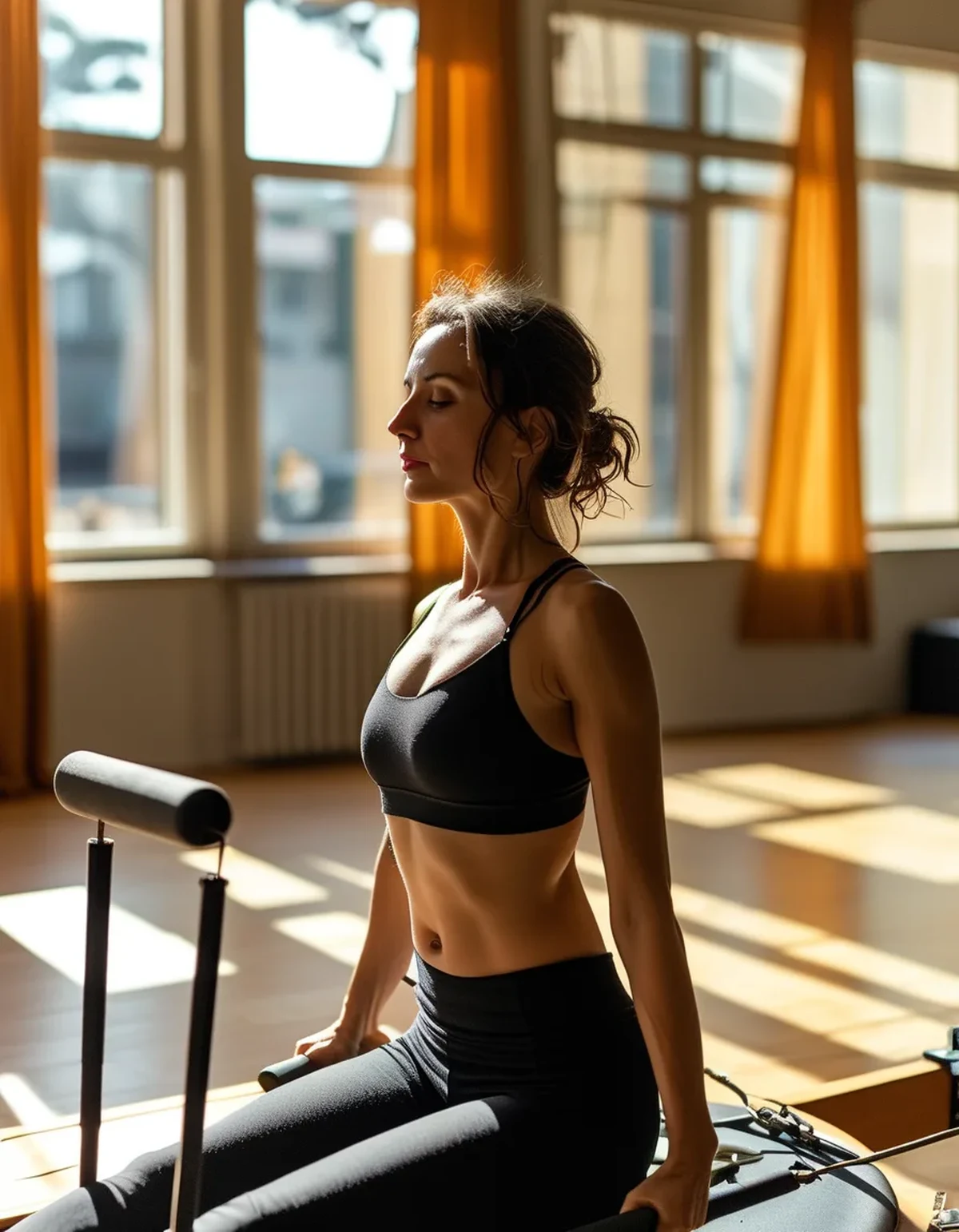
Because reformers are genuinely not standardised.
Spring colours mean different tensions on different brands. A red spring on one manufacturer’s machine is not the same resistance as a red spring on another. Instructor cues given in colours do not transfer between studios.
Spring age changes tension. Springs lose tension over years of use, so an old machine with the same springs is meaningfully lighter than a new one. This is why a familiar exercise feels different in a studio that recently replaced them, a topic covered separately on this blog.
Carriage weight and rolling resistance differ. Some carriages are heavier and some roll more freely, both of which change the effective load independently of the springs.
Footbar height and position vary. This changes the angle of your push and which muscles do the work, sometimes substantially.
Rope and strap length is adjustable and often adjusted by whoever used it last. Starting position changes the range of motion, which changes the exercise more than most people realise.
And your own position on the carriage changes the leverage. A few centimetres higher or lower on the shoulder rests changes the mechanics of many exercises.
Which is why comparing spring settings between studios is not meaningful. Use how the movement feels and whether you can control it, rather than trying to reproduce a number from elsewhere.
What Nobody Tells You About Reformer Training
Heavier springs are frequently easier, not harder. In many exercises the spring supports you, so adding tension reduces the work. This is the most counterintuitive thing about the equipment and it is why instructors sometimes reduce your springs to make something harder.
The reformer is excellent at hiding compensation. The machine keeps you in a good path even when your own control is poor, which means you can perform an exercise well without having built the underlying stability. Mat work has no such courtesy.
Progress is hard to track and easy to lose sight of. Without weights or reps to record, people practise the same settings for a year. Noting spring settings, positions, and rep counts makes progression visible.
Group class pace is set for the room, not for you. In a mixed-level class, the tempo is a compromise, and slowing down deliberately is usually more productive than keeping up.
It is genuinely excellent for working around limitations. The support that reduces stabiliser demand is exactly what makes it valuable for people managing injuries, joint problems, or returning after time off. The tradeoff is a feature in that context.
And mat Pilates is the harder discipline for most people, not the beginner version. The equipment-free option is frequently taught as the entry point, which has it exactly backwards in terms of difficulty.
FAQ: Reformer and Mat, Answered
Why is mat Pilates harder than the reformer?
The reformer provides external stability and guides the movement path, and its springs often assist. On a mat you supply all the stabilisation and control yourself, which is a distinct and demanding quality.
Do heavier springs make an exercise harder?
Not always. In exercises where the spring assists your return or supports part of your weight, more tension makes it easier. This is why instructors sometimes reduce springs to increase difficulty.
Should I do both reformer and mat?
Yes. Fifteen minutes of mat work twice a week alongside reformer classes closes the stabilisation gap, and the two complement each other unusually well.
TL;DR:
- The reformer provides external stability and guides the movement path, so your deep stabilisers do less than on a mat.
- Strength and movement patterns transfer well; stabilisation and unsupported holds do not.
- Heavier springs frequently make exercises easier because the spring assists you, which is why instructors reduce them to add difficulty.
- Spring colours, spring age, and carriage weight are not standardised, so settings do not transfer between studios.
Add fifteen minutes of mat work twice a week. It is the cheapest possible fix for the only real gap in reformer training.
Keep Reading
This article is for general informational and styling purposes only. Fit, sizing, and product availability may vary.