Why Your Grip Socks Change a Reformer Exercise More Than You Think
Quick Answer: Grip socks change how much your foot can slide and how much sensory information it receives, which decides how hard your foot and ankle stabilisers work. A high-coverage grippy sole locks the foot in place and shifts effort up the chain to the hips; a sparse or worn pattern lets the foot micro-slide, so the foot and calf work harder. Neither is wrong — but switching pairs mid-programme changes the exercise, and that is worth knowing.
You borrowed a pair from the studio because you forgot yours.
Footwork feels weirdly hard. Your calves are talking to you by the second set, and the carriage feels less controlled at the end of the range.
Same machine, same springs, same instructor. The variable is under your feet, and it is a bigger one than it looks.
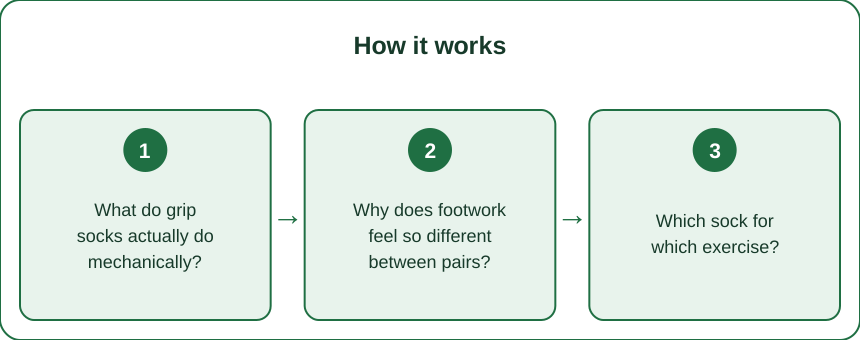
What do grip socks actually do mechanically?
Two things, and they pull in opposite directions.
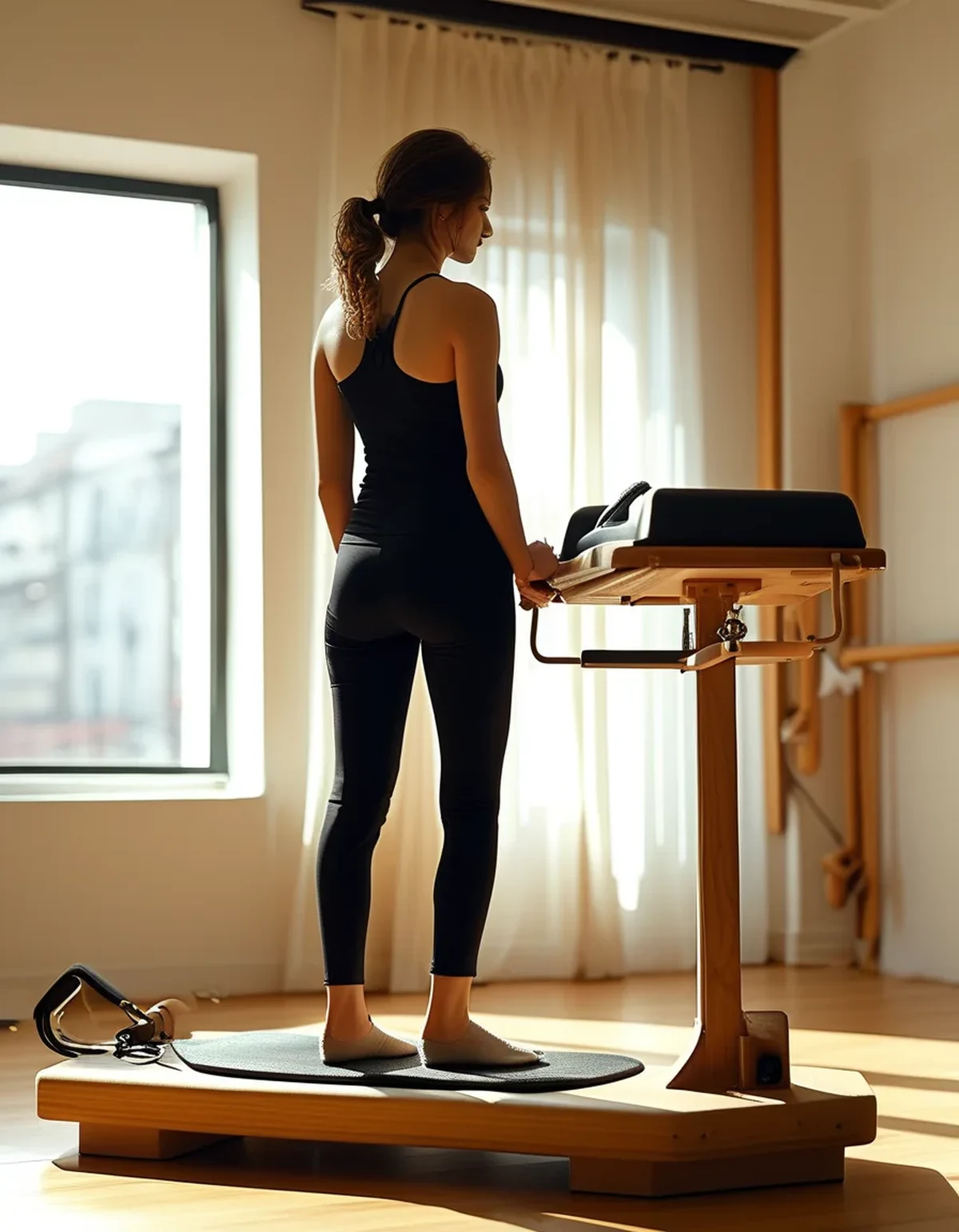
They increase friction at the interface. Silicone dots grip the footbar, the carriage and the floor. This stops the foot sliding, which is the safety rationale and the obvious purpose.
They change sensory input. A sock with dense silicone coverage is stiffer and thicker under the foot, and it damps the tactile information your sole receives from the bar. Feet are dense with mechanoreceptors, and Pilates relies heavily on that feedback.
The consequence is a trade-off. More grip means less foot work. If the foot cannot slide at all, the intrinsic foot muscles and the calf have less to stabilise against, and effort transfers to the hip and trunk.
Less grip means more foot work, because your foot is constantly making small corrections to stay where you put it. That is either useful training or an unwanted distraction, depending on what the exercise is for.
Why does footwork feel so different between pairs?
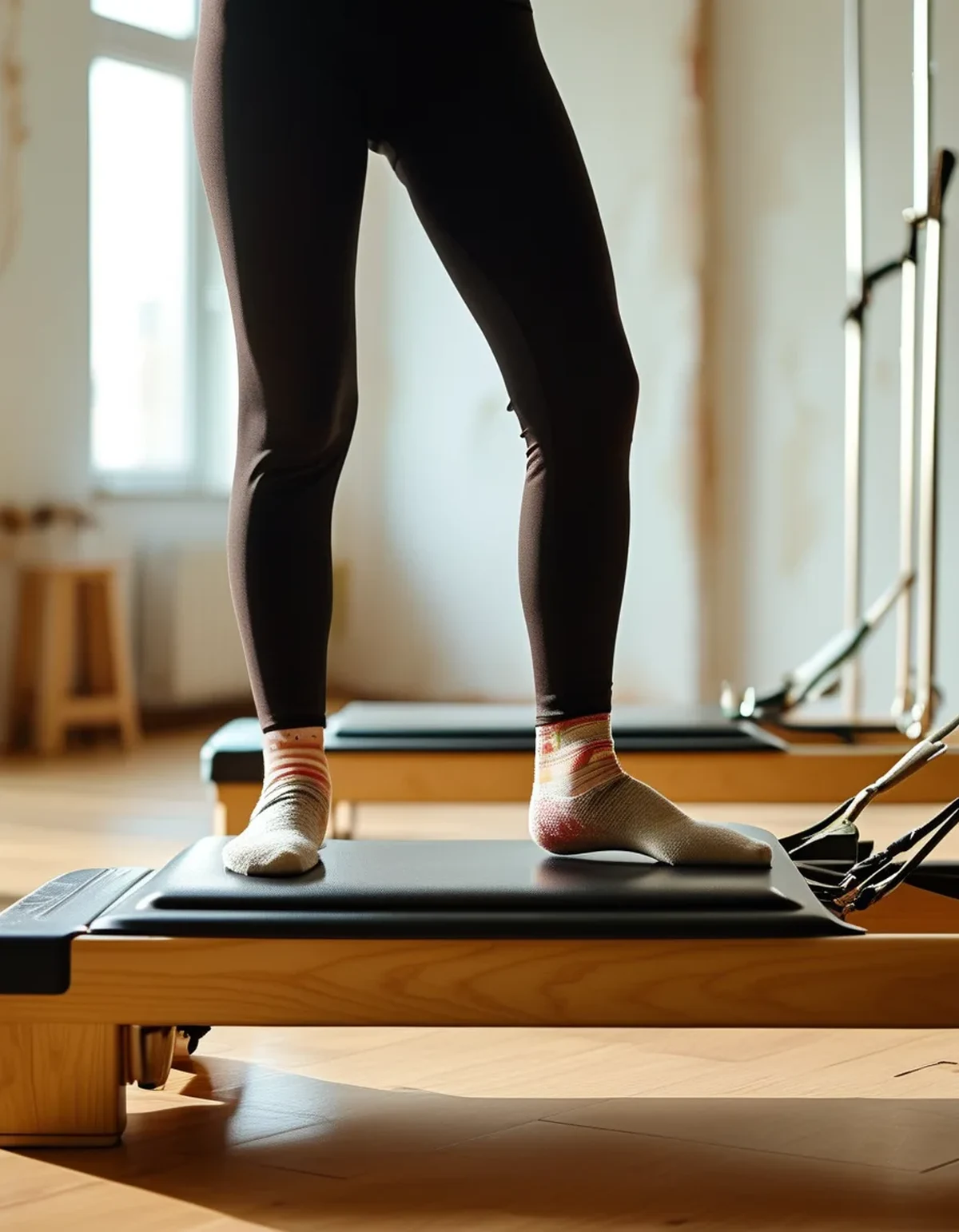
Because footwork is the exercise where the foot-to-bar interface is the whole story.
In footwork, your feet are the only contact point with the fixed end of the machine. Everything about how force is transmitted goes through that contact.
With a high-grip sock, your foot position is locked. You can press through a precise part of the foot and it stays there. The exercise becomes cleaner and more hip-and-thigh dominant.
With a low-grip or worn sock, your foot slides a millimetre or two under load and returns. That micro-movement is continuously corrected by the foot and calf. Over 20 reps it is a genuine additional workload — which is why borrowed socks can leave your calves sore.
In heel positions specifically, grip matters most, since the contact area is small and the force vector is more likely to produce slide.
There is also a height effect: a thick, heavily dotted sole raises the foot a couple of millimetres off the bar, which subtly changes ankle angle in ways that are noticeable in a full range footwork series.
Which sock for which exercise?
A rough guide, assuming you own two pairs:
High grip is better for:
- Standing work on the carriage — split stance, lunges, anything where a slip is a genuine risk.
- Kneeling work, where hands and knees both need reliable contact.
- Long spine and jumpboard work, where a foot leaving position mid-movement is disruptive.
- Anyone new to the reformer, where confidence in the contact allows attention to go elsewhere.
Lower grip or thinner sock is better for:
- Footwork series, if you want the foot and ankle working.
- Any exercise where foot articulation is the point — prehensile work, toe and arch exercises.
- Advanced control work, where damped feedback is a real cost.
Bare feet sit at the extreme end: maximum sensation, minimum security, and not permitted in many studios for hygiene reasons.
Myth vs Fact: Pilates Grip Socks
Myth: Grip socks are just a hygiene rule. Fact: hygiene is one reason, but slip prevention on a moving carriage is a genuine safety function, and the mechanical effect on the exercise is real.
Myth: More dots is always better. Fact: full-coverage silicone gives maximum grip and minimum feel. For footwork and articulation work, that is a downgrade rather than an upgrade.
Myth: Worn-out grip socks are fine as long as they stay on. Fact: silicone wears smooth over time, and a sock that grips inconsistently — some areas worn, some not — is worse than one that grips uniformly less. Uneven friction is unpredictable friction.
Myth: The sock does not matter compared with spring setting. Fact: spring tension has the larger effect on total load, but the sock changes which tissue does the stabilising. Two different questions.
Does the season change what you should wear?
More than you would expect, largely through studio temperature.
Cold studios change everything about your feet. Cold feet have reduced tactile sensitivity, and cold silicone is firmer and slightly less grippy than warm silicone. Both effects push in the same direction — less feel, less grip — in the first few minutes of a class.
Autumn and winter classes start colder. The first five minutes of a reformer class already feel hardest in a cool studio, and springs themselves behave differently when cold. Foot interface is one more variable in that same window.
Thicker socks come out. Warmer autumn grip socks are usually thicker, which damps sensation further and raises the foot slightly. If you switch to a winter pair, expect footwork to feel different for a session or two.
Practical adjustment: arrive early enough to warm your feet up, and if you have a thin and a thick pair, use the thin one for footwork-heavy classes even in winter. A pair of loose socks over the top between exercises solves warmth without changing the interface.
FAQ: Reformer Sock Questions, Answered
How often should I replace grip socks?
When the silicone starts looking shiny and smooth rather than matte, or when grip becomes noticeably uneven across the sole. For regular practice that is often every six to twelve months.
Do full-foot grip patterns matter versus toe-and-heel only?
Yes. Toe-and-heel patterns leave the midfoot free, which preserves more sensation and is often a good compromise. Full-coverage is the most secure and the least sensitive.
Can I use running or yoga grip socks?
Yoga grip socks are usually fine. Running socks generally are not — they have no grip and can slide alarmingly on a moving carriage.
Why do my feet cramp in grip socks?
Often a tight cuff restricting circulation, or intrinsic foot muscles working harder than usual against a low-grip sole. Check the fit first, then look at whether your socks have worn smooth.
TL;DR:
- Grip socks change friction and sensory input, and those decide whether your foot and calf or your hips and trunk do the stabilising.
- Footwork is the most sock-sensitive exercise on the reformer, because the foot is the only contact with the fixed end.
- Use high grip for standing, kneeling and jumpboard work; thinner, lower grip for footwork and foot articulation.
- Cold studios reduce both feel and grip, and winter socks are thicker — expect a session or two of adjustment.
Springs get all the attention. The two millimetres of silicone under your foot quietly decides which muscles show up.
Keep Reading
This article is for general informational and styling purposes only. Fit, sizing, and product availability may vary.