Why Reformer Footwork Feels Completely Different From One Studio's Machine to Another
Quick Answer: Reformer carriages vary in weight, roller-bearing quality, and spring calibration between brands and even between individual machines, so the same numbered spring setting can produce a meaningfully different resistance feel from one reformer to the next, independent of your technique.
It’s a common source of confusion for regular reformer-goers — footwork that feels manageable at your home studio can feel surprisingly different at a new one, using what should be the same setting.
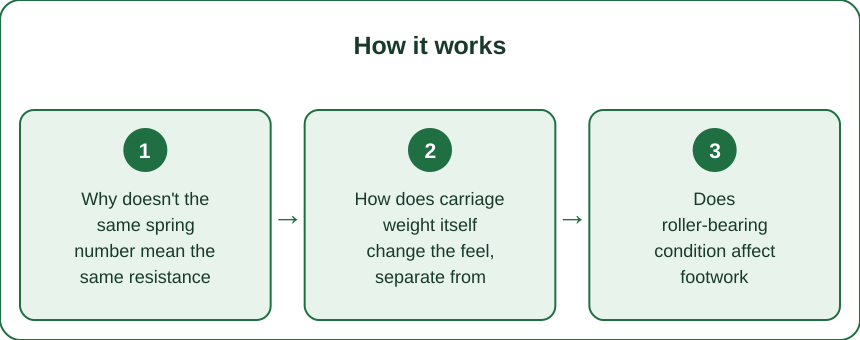
Why doesn’t the same spring number mean the same resistance across brands?
Spring tension calibration isn’t standardized industry-wide, so a “medium” spring on one manufacturer’s reformer can provide meaningfully more or less resistance than a “medium” spring on another brand’s machine, even though both are labeled the same way. This means comparing spring numbers across different reformer brands is not a reliable way to predict how a session will feel.
How does carriage weight itself change the feel, separate from springs?
Heavier carriages require more force just to initiate movement, which adds a baseline resistance layer on top of whatever the springs provide, meaning two reformers at identical spring tension can still feel different if their carriage weights differ. This is part of why some studios’ machines earn a reputation for feeling “harder” even at supposedly equivalent settings.

Does roller-bearing condition affect footwork specifically?
Yes — older or less well-maintained roller bearings create more friction as the carriage slides, which adds resistance you have to work against beyond the intended spring tension, particularly noticeable during footwork’s repetitive back-and-forth motion. A well-maintained machine glides more smoothly, which can make the same nominal spring setting feel lighter than it does on a machine with worn bearings.
Myth vs Fact: Reformer Machine Differences
Myth: If the spring setting number is the same, the resistance is the same. Fact: Spring calibration varies by manufacturer and even by individual machine condition, so the same number doesn’t guarantee the same feel.
Myth: If a machine feels harder, your form has gotten worse. Fact: Machine-specific factors like carriage weight and bearing condition can fully explain a harder feel, independent of technique.
Myth: All reformers within the same studio feel identical. Fact: Individual machines wear differently over time, so even reformers in the same room can develop slightly different feels.
FAQ: Reformer Machine Differences Questions, Answered
Should I ask instructors which spring setting to start with at a new studio?
Yes — telling an instructor your typical spring setting at your home studio and asking them to help calibrate for the new machine is a practical way to find an equivalent starting point.
Is it normal to feel noticeably weaker during a first session on an unfamiliar reformer?
Yes, this is a common and expected experience given the real mechanical differences between machines, not a sign of an actual strength change.
Does this variability mean spring numbers are useless as a reference?
Not useless, just imprecise across brands — they’re still a reasonably reliable reference within the same machine or same studio’s equipment.
TL;DR:
- Spring tension calibration isn’t standardized across reformer brands, so identical numbers can feel different
- Carriage weight adds a baseline resistance layer independent of spring settings
- Roller-bearing condition affects how much extra friction you’re working against during footwork
- Feeling weaker on an unfamiliar machine is a normal mechanical difference, not a form or fitness issue
Next time a new studio’s reformer throws you off, it’s probably the machine talking, not your body — a quick check-in with the instructor about spring equivalents usually clears it right up.
Keep Reading
This article is for general informational and styling purposes only. Fit, sizing, and product availability may vary.