Why a Reformer Class Feels Hardest in the First Five Minutes and Easiest at the End
Quick Answer: The first five minutes of a reformer class feel hardest because you are cold, your motor patterns for the movement have not been recruited yet, and footwork uses the heaviest spring load of the entire class. By minute fifteen your tissues are warmer, your recruitment is more efficient, and the springs have usually been reduced. Nothing about the exercise got easier - your ability to produce and coordinate force improved within the session. Arriving five minutes early to move changes the entire first block.
Footwork on three springs feels brutal, and twenty minutes later you are doing something objectively harder without complaint.
That gap is warm-up, and most people spend it wondering what is wrong with them.

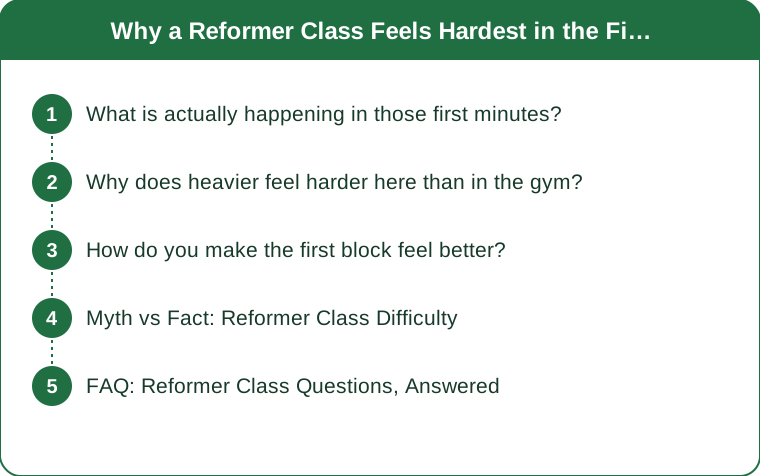
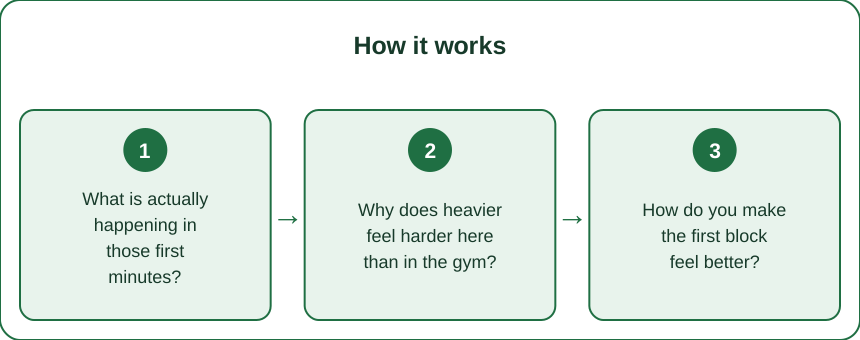
What is actually happening in those first minutes?
Muscle produces force less efficiently when cold. Warmer muscle contracts and relaxes faster, and the difference is large enough to feel within a single session.
Motor recruitment takes a few minutes to organise. The specific pattern for pressing a carriage away with the legs while stabilising the pelvis is a learned coordination, and it comes online during the first block rather than at the door.
Footwork is usually the heaviest spring setting in the class. Most reformer sequences start with the largest muscle groups and the highest load, which means the first thing you do is also the most loaded thing you do.
You are also horizontal immediately. Going from standing to supine changes blood distribution and the way your abdominal wall has to work, and that adjustment takes a few minutes.
Breathing is not settled yet either, and Pilates breath patterns are a coordination in themselves - fighting the pattern costs effort that later feels free.
And you have not yet calibrated to the machine. Carriage weight, strap length and footbar height vary between machines, and the first few reps are partly measurement.
Why does heavier feel harder here than in the gym?
Reformer springs get harder as they stretch, which is the opposite of a dumbbell. Resistance is lowest at the start of the push and highest at full extension.
So the hardest part of a rep is where your leverage is worst, and cold legs feel that specifically at the end of the range.
Spring numbers are not comparable across brands. A red on one manufacturer’s reformer is not a red on another’s, which is why the same class in a different studio feels different.
Heavier springs in some exercises are actually easier, because they support the carriage - in feet-in-straps work, more spring can mean more assistance rather than more challenge.
Which makes the first block confusing to interpret. Heavy footwork is genuinely heavy; heavy elsewhere may not be.
And instructors reduce springs as class progresses for exactly this reason - lighter springs demand more control, and control is what the later blocks are training.

How do you make the first block feel better?
Arrive five minutes early and move. Walking, a few squats, some ankle circles and shoulder rolls change the first block more than any adjustment on the machine.
Ask for one spring lighter for footwork if you are cold, and add it back for the second set. This is a completely normal request.
Set the footbar height deliberately before class starts, since footbar position changes the exercise more than most people realise.
Do the first set at a slower tempo, which improves recruitment and gives you an extra thirty seconds of warming before load matters.
Breathe out on the effort from the very first rep rather than settling into it by rep ten.
Take the first set as calibration, not performance. Compare yourself to your usual second set instead.
And if you came straight from a desk, expect the hip flexors to complain first - that is seated posture, not the reformer.
Myth vs Fact: Reformer Class Difficulty
Myth: if the warm-up feels hard, the class will be too hard. Fact: the warm-up frequently carries the heaviest spring load of the session, and difficulty usually falls even as the exercises become more complex.
Myth: more springs always means harder. Fact: in feet-in-straps and several arm exercises, added spring supports the carriage and reduces the demand. Spring load and difficulty are not the same axis.
Myth: the spring colour tells you the resistance. Fact: colour coding is manufacturer-specific. A studio switching brands changes what every colour means, which is why a familiar class can feel unfamiliar in a new location.
Myth: feeling shaky means you are working correctly. Fact: shaking usually means the load exceeds what you can control at that range. It is information, not a target, and the useful response is usually one spring lighter or a shorter range.
Myth: you should push to full range every rep. Fact: the end of the range is where spring resistance is highest and leverage is worst. Full range with a collapsed pelvis is not more advanced than partial range with control.
Myth: the instructor adjusting your springs means you are struggling. Fact: spring changes are how the class is programmed. Being moved lighter often means the next exercise demands control rather than force.
FAQ: Reformer Class Questions, Answered
Why is footwork the hardest part of class?
It uses the heaviest spring setting, it comes before you are warm, and it is the first time in the session your legs have to coordinate the movement. All three peak simultaneously.
Should I ask for lighter springs at the start?
Yes, this is routine. Start one lighter for the first set and add it back once you are warm - instructors expect and encourage this.
Why does the same class feel harder in another studio?
Spring colour coding differs by manufacturer, carriage weight varies, and footbar and strap dimensions are not standardised. The class is the same; the machine is not.
Does arriving early actually help?
Noticeably. Five minutes of walking and general movement means the first block starts warm, which is exactly the window that otherwise feels worst.
Is it normal for the end of the push to feel hardest?
Yes. Springs increase resistance as they stretch, so the end of the range is the highest-load part of every rep - the opposite of free weights.
My legs shake during footwork. Is that bad?
It generally indicates load beyond your current control at that range. Reduce the spring or shorten the range rather than pushing through. This is general information, not medical advice.
TL;DR:
- Footwork is usually the heaviest spring load of the class and arrives before you are warm.
- Cold muscle produces force less efficiently, and motor recruitment takes minutes to organise.
- Reformer springs get harder as they stretch, so the end of each push is the hardest part.
- More springs is not always harder - in strap work it often assists.
- Spring colours are manufacturer-specific, which is why other studios feel different.
- Arriving five minutes early and moving changes the first block more than anything on the machine.
Treat the first set as calibration rather than performance, and the class stops feeling backwards.
Keep Reading
This article is for general informational and styling purposes only. Fit, sizing, and product availability may vary.