Why the Reformer Carriage Feels Heaviest at the End of the Range
Quick Answer: A spring’s resistance increases in proportion to how far it is stretched, so the further the carriage travels, the harder it pulls back. Meanwhile your muscles are approaching the end of their range, where they produce less force. The load rises exactly as your capacity falls. That is why the last few inches feel disproportionately hard - and why the end of the range is where technique breaks. It is the machine’s defining property, not a fault.
Understanding this changes how you interpret almost every cue you receive on a reformer.
And it explains why the same exercise feels completely different on a different machine.
Why does spring resistance increase with distance?
Because that is how springs work, and it is fundamentally different from free weights.
A spring’s force is proportional to how far it is stretched. At the start of the movement it is barely extended and pulls gently. At full extension it is pulling hardest. This is the opposite of a dumbbell, which weighs the same throughout the movement.
So the resistance curve on a reformer is ascending. Easy at the start, hardest at the end. On a free weight the resistance is constant, and the difficulty curve comes entirely from your changing leverage.
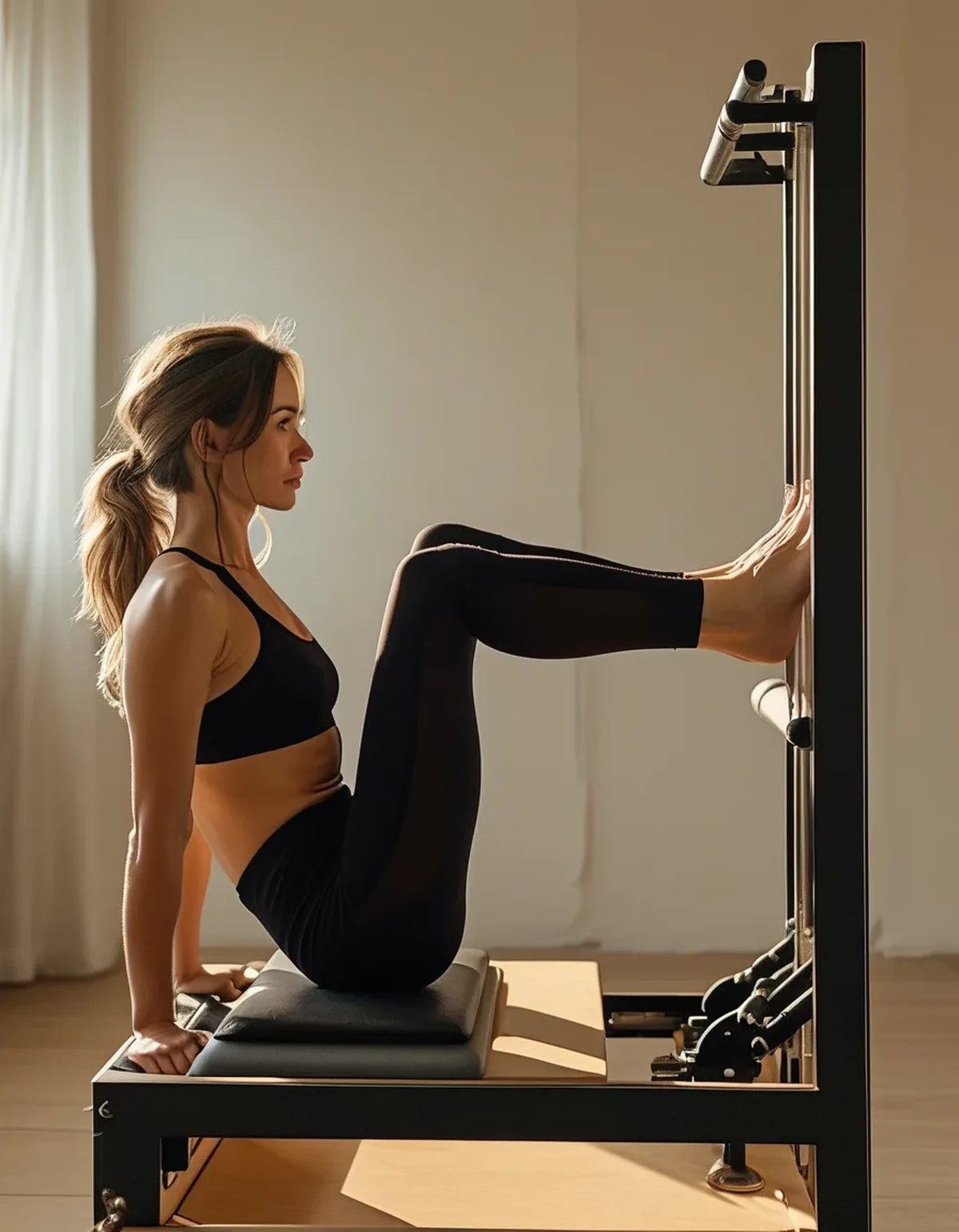
Your force production is doing the opposite. Muscles produce less force at very short and very long lengths, with a peak somewhere in the middle. In most reformer exercises, the end of the carriage travel corresponds to a position where the working muscle is shortened and weaker.
Rising load meeting falling capacity is why the last few inches feel disproportionate. It is not a small effect - the resistance at full extension can be substantially higher than at the start, depending on the spring and the machine.
And it explains the classic instruction to control the return. The spring is doing its most enthusiastic pulling at the far end, which is exactly where a lapse in control produces a fast, uncontrolled carriage return.
Why does the same exercise feel different on another machine?
Because spring systems are not standardised in any meaningful way.
Spring colours mean different things on different brands. A red spring on one manufacturer’s reformer is not the same tension as a red on another. There is no industry standard, which is why a class at a new studio can feel completely wrong at your usual settings.
Springs also lose tension over their lifespan. A spring used for years in a busy studio delivers less resistance than a new one, gradually and invisibly. When a studio replaces springs, regulars often report everything suddenly feeling harder - and they are right.
The gearbar position changes the starting stretch. Moving the gearbar changes how much the spring is already extended at the carriage’s home position, which shifts the entire resistance curve. Two people on identical machines with different gearbar settings are doing different exercises.
Rope and strap length changes where in the carriage travel your working range sits. Longer ropes mean you work in a section of the range where the spring is more extended - and therefore heavier - even at the same spring setting.
And carriage friction varies with maintenance. A well-maintained carriage glides; one needing service adds friction that changes the feel in both directions.
Practical implication: your spring setting is specific to that machine, that day. Adjust by feel each time rather than by memory of a colour.
Does lighter spring mean easier?
No - and this is the counterintuitive point that catches most people.
Lighter springs are frequently harder. The spring provides support as well as resistance, and in many exercises it is doing a substantial share of the stabilisation for you. Remove it and your own muscles must supply that control.
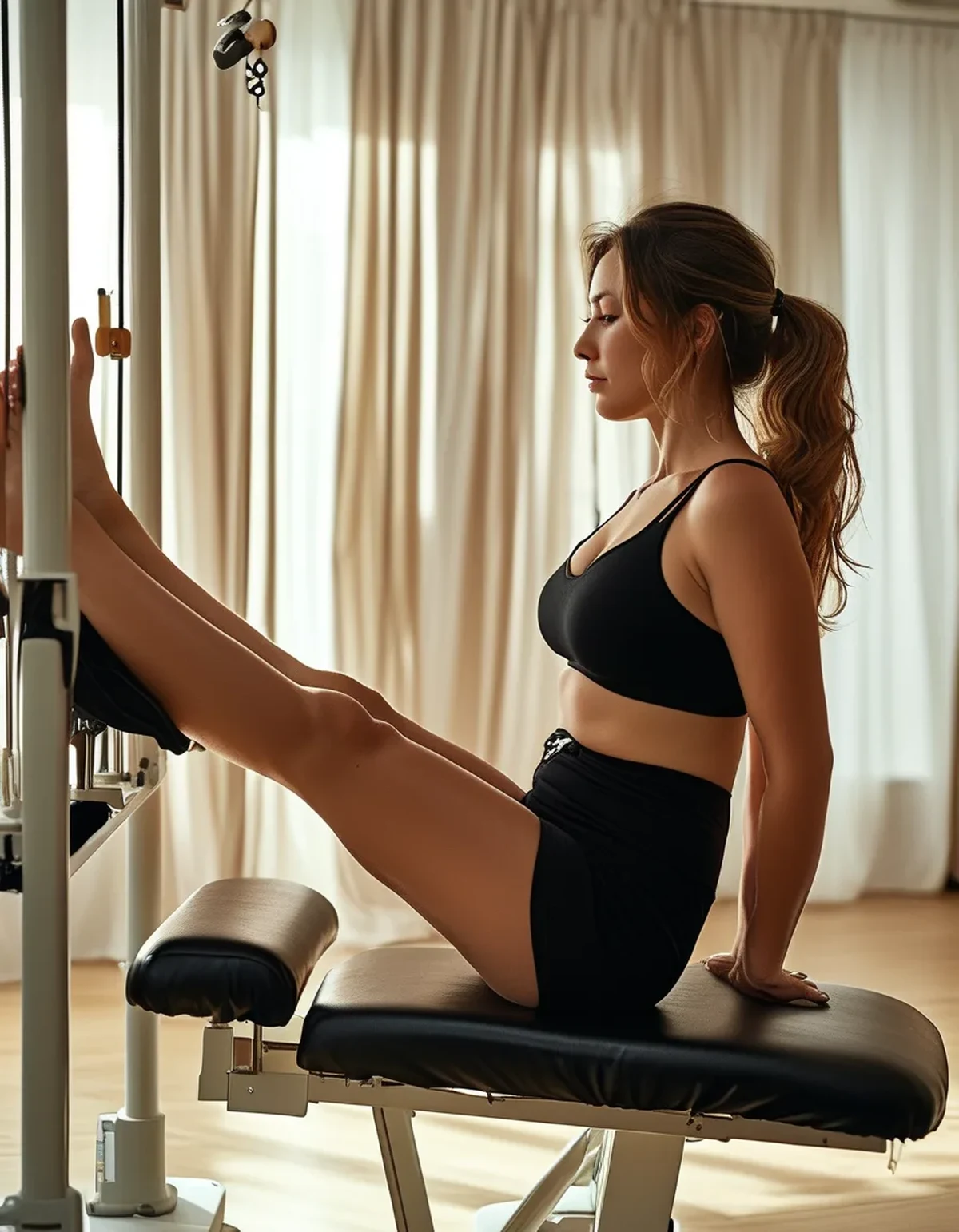
The clearest example is any exercise where the carriage returns toward you. A heavier spring resists the return and helps you control it. A light spring means you control it entirely. Long stretch, elephant, and most kneeling work are far more demanding on light springs.
The other case is stability. A heavier spring holds the carriage more firmly in place, giving you a more stable base. Light springs let the carriage move at the slightest asymmetry, which demands much more control.
Conversely, heavier springs are genuinely harder for pushing away, where you are working directly against the tension - footwork and leg press being the obvious cases.
Which is why the instruction to lighten the springs is often an increase in difficulty, and why an instructor may add spring for a beginner and remove it for an advanced student on the same exercise.
The question to ask is: is the spring resisting me or supporting me here? If it is supporting, less spring is harder. If it is resisting, more spring is harder. That single question resolves most of the confusion.
What Nobody Tells You About Reformer Springs
The end range is where technique fails, for the reasons above. Watch anyone in footwork and the knees will hyperextend or the pelvis will shift in the final few inches - the load is highest and control is lowest at exactly that point. Stopping just short of full extension is not a compromise; it is often better training.
Spring noise tells you something. A spring that clunks or twangs is being loaded unevenly or too fast. Smooth movement is quiet, and quiet is a genuinely useful feedback signal you already have.
Springs warm up. A cold studio’s springs are marginally stiffer than the same springs an hour into a busy day. This is small but real, and it is part of why the first exercise of a class feels hardest.
The eccentric phase is where most of the benefit lives. The carriage returning under control is a lengthening contraction under high spring load, and lengthening contractions produce strong adaptation. Rushing the return skips the most valuable part of the repetition.
Half springs exist and are underused. Many machines allow a half setting, and the jump between whole springs is often too large - particularly for smaller people. Ask whether your machine supports it.
And spring tension is not a measure of your progress. Advancing often means fewer springs, slower tempo, and greater range, not more resistance. Someone using two red springs is not necessarily working harder than someone on one blue.
FAQ: Reformer Spring Questions, Answered
How do I know if my spring setting is right?
You should be able to complete the full range with control and consistent tempo, and the last few inches should be challenging but not a struggle. If the end range breaks your form or you cannot control the return, adjust.
Why does my instructor keep changing my springs mid-class?
Because different exercises need different settings for the same person, and the spring’s role flips between resisting and supporting depending on the movement. It is not an assessment of your ability.
How often should studio springs be replaced?
It varies with use, but springs lose tension gradually over years and most studios replace on a schedule rather than on failure. If everything suddenly feels harder after a maintenance week, new springs are usually why.
TL;DR:
- Spring resistance rises with distance travelled - the carriage genuinely is heaviest at full extension.
- Your force production falls at the end of the range, so rising load meets falling capacity.
- Spring colours are not standardised across brands, and springs lose tension with age.
- Lighter is often harder - ask whether the spring is resisting you or supporting you.
- The controlled return is the most valuable part of the repetition; do not rush it.
Next class, notice where in the range your form changes. That point is the spring curve meeting your strength curve.
Keep Reading
This article is for general informational and styling purposes only. Fit, sizing, and product availability may vary.