Why the Exact Same Reformer Class Can Feel Easier or Harder Week to Week
Quick Answer: Week-to-week variation in how a reformer class feels usually comes down to factors outside the workout itself — sleep quality, hydration, hormonal cycle phase, and even how recently you last did strength or cardio training all affect how much effort the same spring resistance and routine actually requires from your body.
The workout genuinely is the same. What varies is the body showing up to do it, in ways that are mostly normal and expected.

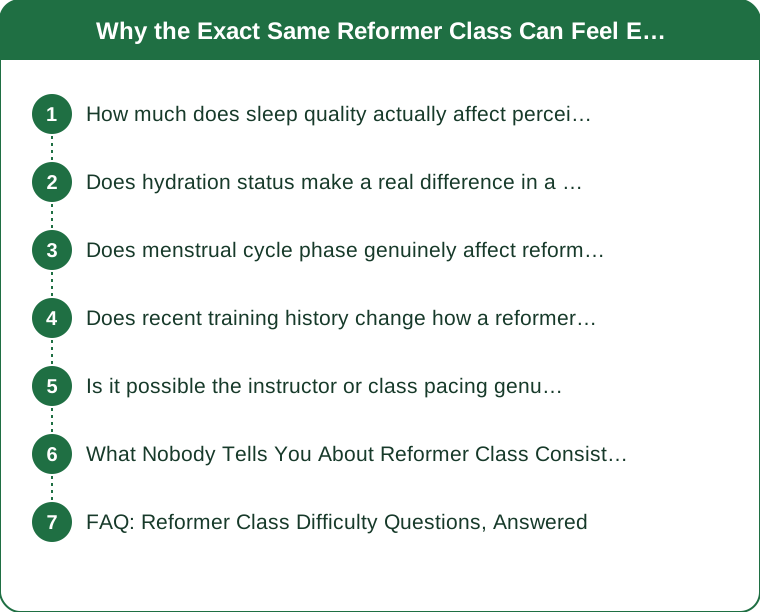
How much does sleep quality actually affect perceived reformer difficulty?
Meaningfully — poor sleep reduces both muscular power output and pain/fatigue tolerance, meaning the same spring resistance can feel notably more effortful after a rough night’s sleep compared to a well-rested one, independent of any change in actual fitness.
Does hydration status make a real difference in a single class?
Yes — even mild dehydration reduces muscular endurance and increases perceived exertion, so a class taken after a poorly hydrated day can feel harder throughout, particularly in longer holds and higher-rep segments that depend on sustained muscular output.
Does menstrual cycle phase genuinely affect reformer performance?
For many people, yes — hormonal fluctuations across the cycle affect energy availability, joint laxity, and perceived exertion, with many reporting classes feeling notably harder in the days just before menstruation and often easier during the follicular phase, though individual patterns vary.

Does recent training history change how a reformer class feels?
Yes — residual fatigue from other recent workouts (strength training, cardio) reduces available capacity for a reformer session, meaning a class taken after a heavy leg day, for instance, will predictably feel harder in leg-focused reformer segments than the same class taken on fresher legs.
Is it possible the instructor or class pacing genuinely varies too?
Yes, to a smaller degree — even with a set routine, instructors adjust pacing, rest between exercises, and cueing intensity somewhat class to class, which can add a modest but real variability layer on top of the factors related to your own body’s readiness.
What Nobody Tells You About Reformer Class Consistency
Instructors and experienced reformer regulars generally expect and normalize this variability, rarely treating a harder-than-usual class as a fitness setback — it’s worth adopting the same framing rather than reading a tough class as a sign of declining fitness.
FAQ: Reformer Class Difficulty Questions, Answered
Should spring settings be adjusted on a harder-feeling day?
It’s reasonable to drop a spring level or two if a class feels unusually difficult, prioritizing form over pushing through with resistance the body isn’t handling well that day.
Is it useful to track factors like sleep and hydration against how classes feel?
For people who want to understand their own patterns, yes — a simple note after class (sleep hours, hydration, cycle phase) can reveal personal trends over a few months.
Does this variability mean progress tracking is unreliable?
Not if tracked over a longer window — day-to-day variability averages out, and genuine strength and endurance trends still show up over weeks and months.
TL;DR:
- Sleep quality measurably affects power output and how hard the same class feels
- Even mild dehydration increases perceived exertion during a session
- Hormonal cycle phase genuinely affects energy and joint feel for many people
- Residual fatigue from other recent workouts changes reformer difficulty independent of fitness
If a usually manageable reformer class suddenly feels much harder, check sleep, hydration, and recent training load before assuming anything’s wrong with your fitness — most weekly variation traces back to these factors.
Keep Reading
This article is for general informational and styling purposes only. Fit, sizing, and product availability may vary.