Why Footbar Height Changes an Exercise More Than the Springs
Quick Answer: Footbar height changes your starting hip and knee angle, which changes which muscles are in their strongest range, how much ankle dorsiflexion you need, and where in the movement the load peaks. Springs change how much resistance you push against; the bar changes what you are pushing with.
You go to a different studio and footwork feels completely wrong on the same springs. You assume their machine is heavier. Look down — the bar is one notch lower than you are used to, and that is the whole explanation.
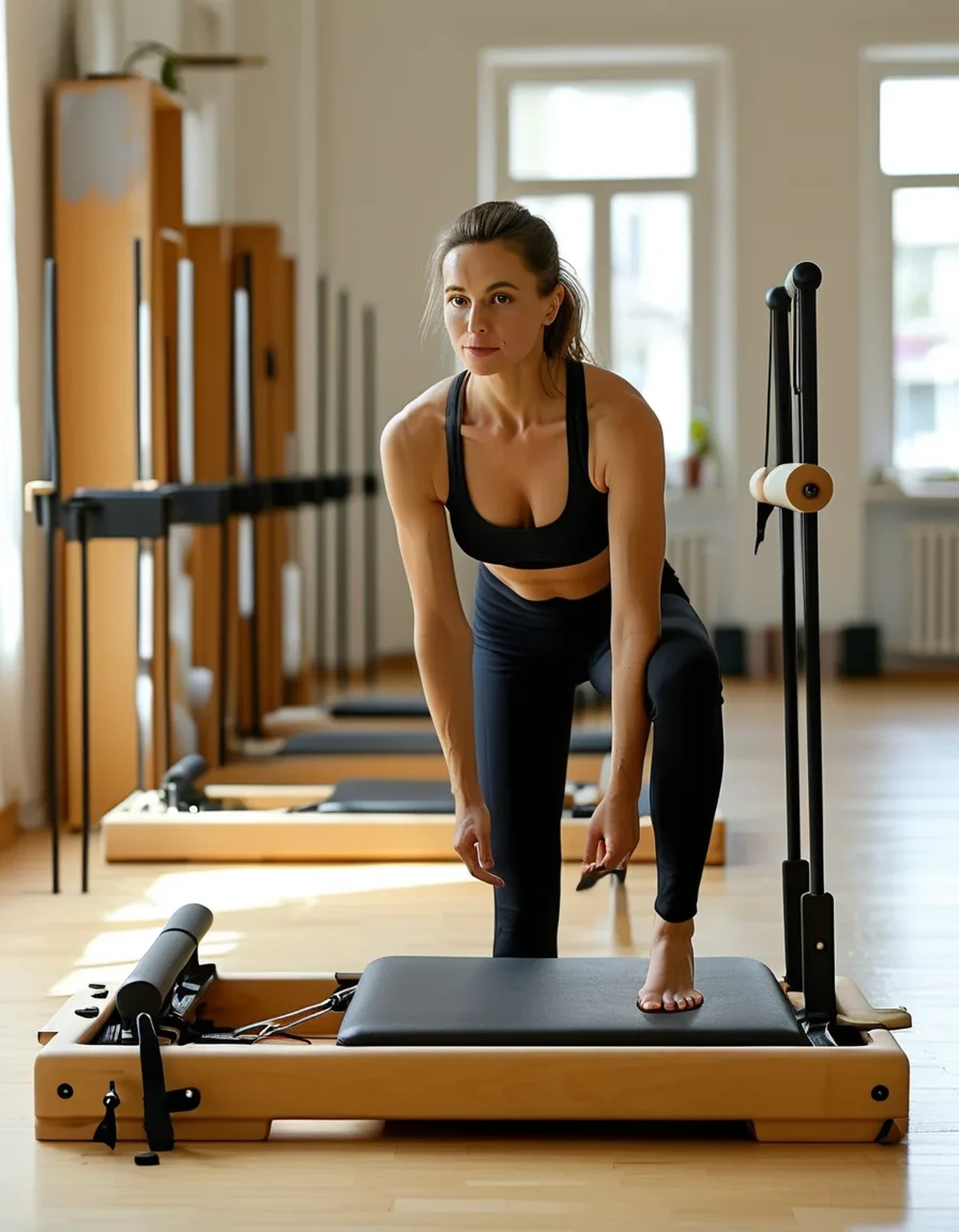
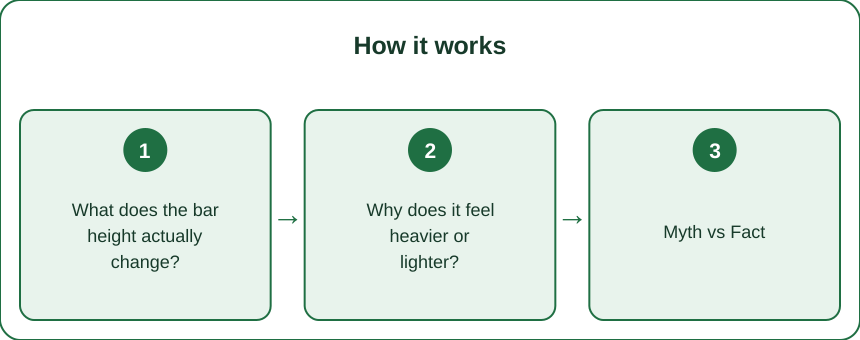
What does the bar height actually change?
Your joint angles at the start of the movement, which determines everything downstream.
With a higher footbar, your knees start more flexed and your hips more closed. You begin the push from a deeper position, which means:
- More range of motion through the whole rep
- The quadriceps working from a longer, more stretched starting position
- More ankle dorsiflexion required, which becomes the limiting factor for many people
- More demand on the low back to keep the pelvis stable at the start
With a lower footbar, you begin closer to extended:
- Shorter range, with the work concentrated nearer the end of the push
- Less ankle demand and less pelvic stability challenge
- More hamstring and glute involvement relative to quad
- Generally more accessible for people with knee sensitivity or limited ankle range
The muscle length at which force is produced changes what the exercise trains, which is why the same spring load feels dramatically different. It is the same principle as the difference between a partial squat and a deep one.
Why does it feel heavier or lighter?
Because of leverage, not because of tension.
The springs deliver a specific resistance regardless of bar height. But your ability to produce force against it varies enormously depending on the joint angle you are at.
A deeply flexed knee at a high footbar puts your quadriceps in a mechanically disadvantaged position at the start of the push. The spring has not changed; your capacity to move it has. So the carriage feels heavier, and it genuinely is harder, without a single spring being altered.
There is a second factor: at a higher bar, more of the movement happens in the range where the spring is stretched further, and reformer springs get progressively heavier as they extend. Combine a mechanically weak starting position with a spring that loads up through the range, and the difference from one bar notch can exceed the difference from swapping a red spring for a blue one.
Which is exactly why an instructor who watches you struggle sometimes moves the bar rather than the spring. It often addresses the problem more precisely.
Myth vs Fact: Footbar and Springs
Myth: Springs are the difficulty setting and the bar is the comfort setting. Fact: Both are difficulty settings, acting on different variables. Springs set resistance; the bar sets the range and leverage you meet it with. Changing the bar can alter perceived difficulty more than changing a spring.
Myth: A higher bar is always harder. Fact: Usually harder for footwork because of the deeper start, but not universally. For some exercises and some bodies, the lower bar’s longer lever and reduced stability is the harder version. It depends on the exercise and on your proportions.
Myth: Everyone should use the same bar height for the same exercise. Fact: Limb length matters a great deal. A taller person with long femurs starts at a much deeper knee angle on the same setting than a shorter person does. Standard settings are a starting point, not a prescription, and this is a large part of why an instructor adjusts new clients.
Myth: If it hurts your knees, lower the springs. Fact: Knee discomfort in footwork is more often a function of starting angle and foot position than resistance. Lowering the bar and checking your alignment usually helps more, and a good instructor will look at the bar first.
How should you choose your setting?
By what you are trying to get out of the exercise, then adjusted for your body.
Choose a higher bar when:
- You want maximum range and a bigger stretch through the quads and hips
- You have good ankle mobility and can keep your pelvis stable at the start
- You are training strength through a deep range deliberately
Choose a lower bar when:
- Your heels lift or your knees drift at the deep start, which means the range is exceeding your available mobility
- You have knee sensitivity, particularly in deep flexion
- You want more posterior-chain emphasis
- You are new and building the pattern before adding range
A useful self-test: set up at the start position and check three things. Can your pelvis stay neutral? Do your heels stay down without strain? Do your knees track over your toes rather than falling in? If any of those fail at the start position, the bar is too high for you today, regardless of what setting you used last month.
That last point is worth sitting with. Ankle mobility and hip range vary with warm-up, time of day, and how cool the studio is — so the right bar height in a warm evening class may not be the right one at 7am in October.
What else changes with the machine?
Reformers are not standardized, which is why the same setting travels badly between studios.
- Bar notch spacing differs by brand. Position three on one machine is not position three on another, and the gap between notches can be an inch or more
- Carriage starting distance from the bar varies, which changes your joint angles independently of bar height
- Spring colors mean different tensions across brands. A red spring on one machine and a red on another can differ meaningfully, which is why an experienced instructor asks what you use rather than assuming
- Headrest and shoulder rest positions shift where your body sits relative to the bar, which changes the effective bar height for you
- Springs age. A studio that replaced its springs recently has heavier resistance than one running five-year-old springs at the same color
Which leads to the only durable approach: learn the position you are looking for, not the number. If you know that your footwork start should have your knees at roughly 90 degrees with heels down and pelvis neutral, you can find that on any machine in about fifteen seconds. If you know only that you use position three on two red, you are relying on a coincidence of equipment.
Worth mentioning to a new instructor at a new studio: tell them the position you are looking for and let them find the setting. That is a much more useful conversation than a number.
FAQ: Footbar Questions, Answered
Should the footbar change between exercises within a class?
Often, yes. Footwork, feet-in-straps work, and standing or kneeling exercises have quite different requirements, and studios that never move the bar are usually prioritizing class flow over precision. Adjusting it takes a few seconds and is worth doing.
Is the bar height responsible for my heels lifting?
Frequently, yes. Heels lifting at the start of footwork usually means the required ankle dorsiflexion exceeds what you have available, and lowering the bar reduces that demand immediately. It can also be a calf mobility issue worth working on separately.
Why does my instructor keep changing my bar and not my springs?
Because the bar addresses range, alignment, and joint angle, which are usually the actual issue when a movement looks wrong. Springs address how much resistance you meet. Instructors generally fix position before they fix load, which is the correct order.
TL;DR:
- Footbar height sets your starting joint angles, which determines range, muscle length, and where load peaks
- The carriage feels heavier at a high bar because of leverage, not because the spring changed
- Choose higher for range, lower for knee comfort and posterior-chain emphasis — and check pelvis, heels, and knee tracking at the start
- Notch spacing, carriage position, and spring age all differ by machine, so learn the position rather than the number
The springs get all the attention because they are color-coded and easy to talk about. The bar is doing at least as much work, and it is the first thing worth checking when a familiar exercise suddenly feels wrong.
Keep Reading
This article is for general informational and styling purposes only. Fit, sizing, and product availability may vary.